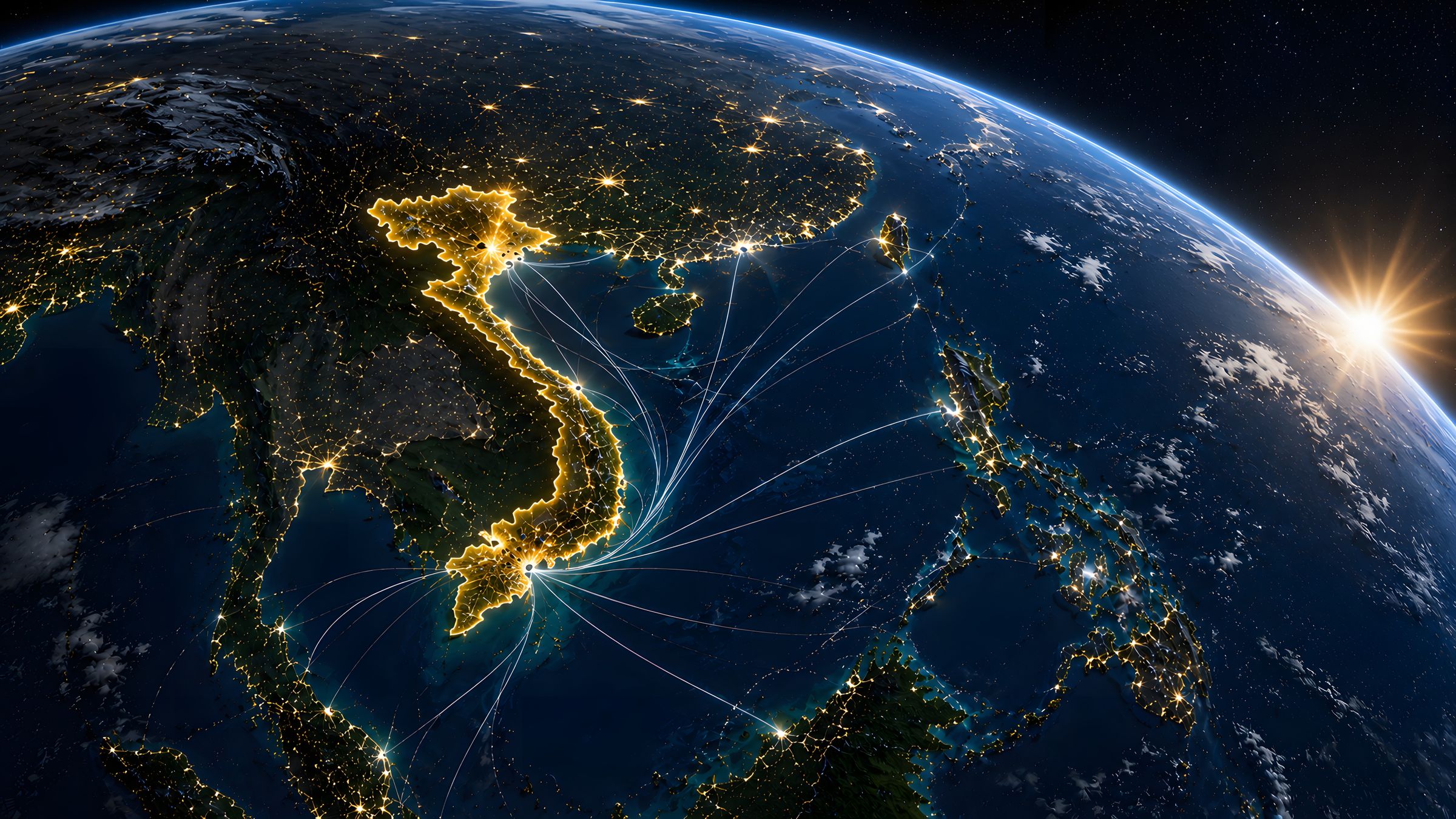
Vietnam's economy grew 6-7% annually for three decades. Poverty fell from 38% to 3.8%. Economic complexity rose 800%. VinFast outsold Toyota by 100,000 units in 2024 in VN, making Vietnam the top EV adopter in ASEAN.
Behind these figures, a different set of numbers runs in parallel. Trade exposure reaches 165% of GDP. The energy balance flipped from 30% exporter to 37% net importer. Seventy percent of the population lives in flood-prone zones. The IMF and World Bank project the 2020s as the slowest growth decade since the 1960s.
The Global Disruption & Trends Report 2026 investigates Vietnam's position in a global reality full of disruption, its weaknesses, its strengths, and their intersection.
Tom Bosschaert (Except, ViCo) and Tam Le spent six months synthesizing data from 25 major reports by the IMF, World Bank, OECD, ADB, WEF, McKinsey, Stanford HAI, UNEP, IEA, IRENA, and WHO. The result is a 54-page analysis built on 91 identified global trends and 24 KPIs tracked across eight domains.
The report is freely available under a Creative Commons license, downloadable below.
What the report covers
Part 1: External Force Field. The global macro events reshaping trade, technology, energy, and demographics. Of the 91 trends identified, 42 carry negative implications, 21 positive, and 28 mixed.
Part 2: Vietnam's Systemic Resilience. An assessment using the Symbiosis in Development (SiD) framework, scoring Vietnam across Resilience, Autonomy, and Harmony (RAH). The profile: strong Harmony (improving), moderate Resilience (mixed signals), and weak Autonomy (declining).
Part 3: The Intersection. Where global forces meet Vietnamese conditions, creating both vulnerabilities and opportunities. The report identifies 12 specific vulnerabilities.
Part 4: Action & Strategic Directions. Eight priority domains with a strategic action matrix for government, business, and civil society.
The seminar
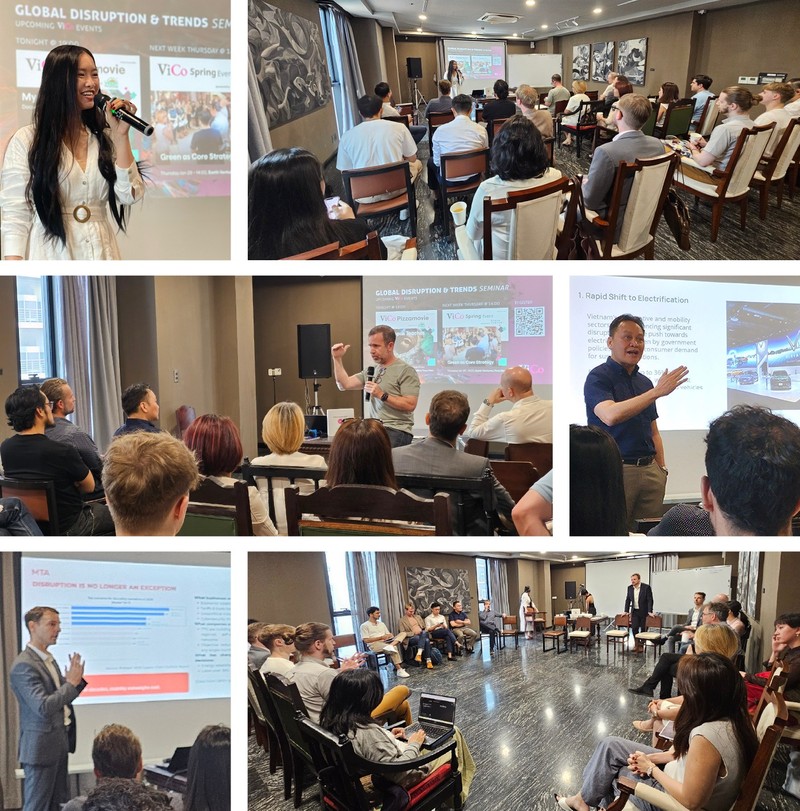
On January 22, 2026, eight experts gathered at Amanaki Hotel in HCMC to test and deepen the report's findings:
Full seminar details: vico.asia/events/global-disruption
Executive conclusion for Vietnam
Vietnam's demographic window stays open for 15-20 years. The country's old-age dependency ratio is 13.4%, while Thailand's already reaches 19% and China's 20%. The decisions made in this window, across energy, trade diversification, education, and urban infrastructure, determine whether Vietnam's next chapter matches the momentum of the last three decades.
This report exists because ViCo's community of 100+ professionals across sectors chose to pool their knowledge. The research is free, openly licensed (Creative Commons BY-NC-SA 4.0), and built for anyone working on Vietnam's future.
Research: Except. Community: ViCo. AI-assisted analysis: BoostGood. Venue: Amanaki Hotel. Strategy & Design: Tom Bosschaert. Research assistant: Tam Le. Event coordination: Kano Nguyen. Relationships: Minh Nguyen.
Download the Report

52 page in-depth research report on the global disruptions coming towards Asia, and Vietnam's position within it.